
Case study · Real-time decisioning for smart cities
Modernizing the app behind a city's fire-safety network
A two-week React Native upgrade that took a Hong Kong smart fire-detection company from a legacy, IoT-blind codebase to a platform ready for LoRaWAN sensors, thermal cameras, and smart-building integration.
THE CLIENT
A fire-safety app that had outgrown its own foundations
FireAlert is a Hong Kong-based smart fire-detection company. Their mobile app is the interface field teams and building operators rely on for live incident visibility — which meant its reliability wasn't optional. But it was still running on React Native 0.7, a version several years and multiple breaking changes behind current.
The challenge: safety-critical, but standing still
An outdated framework version doesn't just mean missing features — on a safety-critical app, it compounds every other risk.
- •Outdated stack: React Native 0.7 lacked support for modern IoT protocols and smart-city APIs the client needed to expand into.
- •Security exposure: the legacy version left fire-safety systems carrying more vulnerability than a critical-infrastructure app should.
- •Performance limits: an inefficient codebase was affecting the real-time responsiveness of fire-alarm monitoring itself.
- •Integration barriers: no path to connect LoRaWAN sensors or thermal cameras — the sensor types smart buildings were standardizing on.
- •Maintenance drag: deprecated APIs made every bug fix and feature slower and riskier than it should have been.
The solution: a full framework migration, without breaking anything critical
WBC ran a systematic migration from React Native 0.7 to 0.81 — auditing every deprecated API, replacing it, and rebuilding compatibility for the app's core fire-safety functions before touching anything else. The upgrade wasn't just a version bump: it was the foundation for connecting the app to the IoT and smart-building ecosystem it needed to serve.
Modern React Native architecture
Migrated to 0.81 with updated security protocols, positioning the app for smart-city API and building-management integrations it couldn't previously support.
IoT sensor connectivity
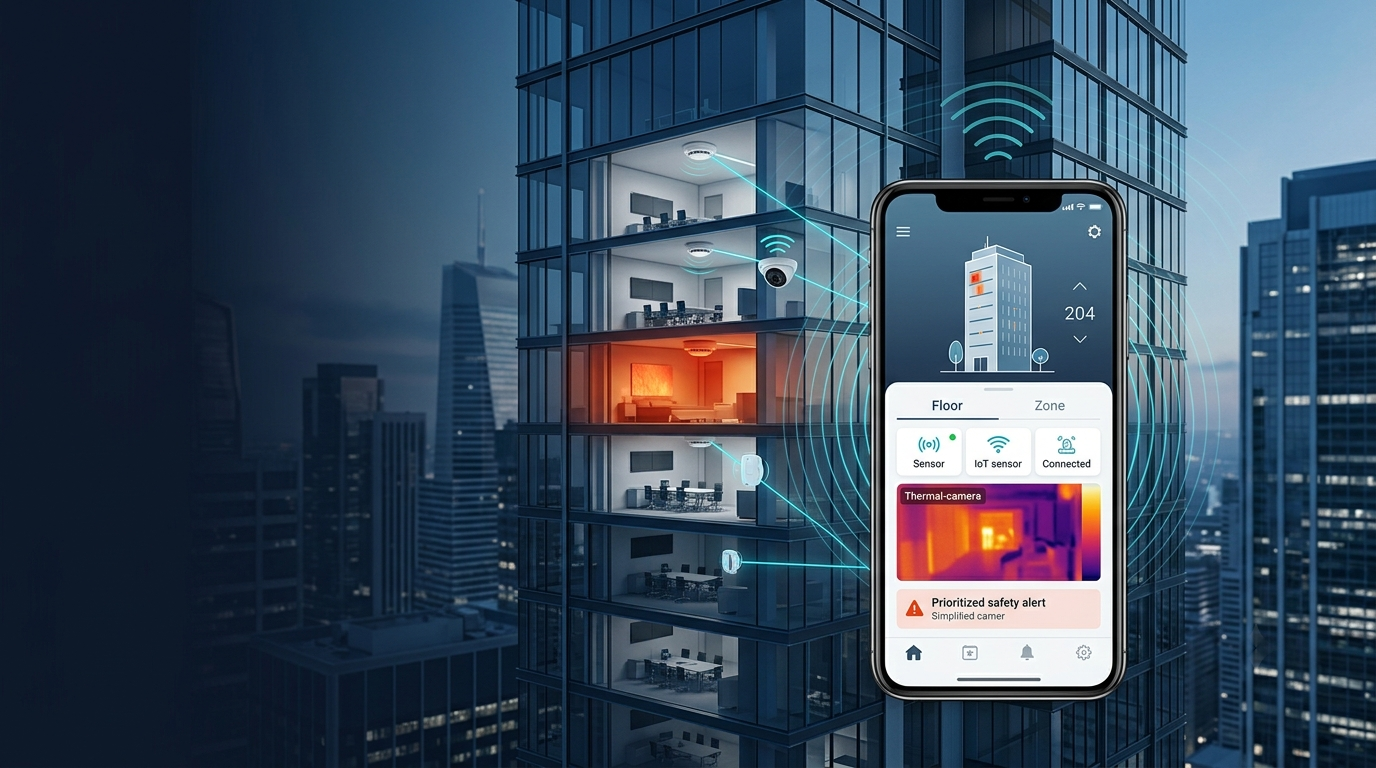
Added support for LoRaWAN wireless fire sensors and thermal-camera imaging, alongside continued compatibility with conventional wired alarm systems.
Smart building integration
Connected the app to building-automation platforms and urban infrastructure systems for real-time monitoring and automated incident alerts.
Cross-platform optimization
Tuned iOS and Android builds independently, including offline capability for the moments a fire-safety app can least afford to be offline.
Delivered in two weeks
Week one covered environment setup, codebase analysis, and the initial migration; week two was testing, bug fixes, and validation — including live testing against real LoRaWAN sensors and thermal cameras, not just simulated data. Daily standups kept the client updated throughout, given how little tolerance a live safety system has for surprises.
A modernized, secure app ready for smart-city-scale IoT integration — delivered in two weeks with zero disruption to a system people's safety depends on.
STACK
Technology
Have a problem like this?
Bring it to a 30-minute discovery call. We’ll tell you honestly what AI can do about it.
Book an AI discovery call